Why Trauma Survivors Parent Differently (And No One Talks About It
Updated: Sep 24
Welcome to Mamahood After Trauma, a space created to support mothers as they heal from trauma, break generational cycles, and discover healthier ways of showing up for themselves and their families. Here, you’ll find honest conversations, practical tools, and encouragement to remind you that healing is possible, one step at a time.

Introduction
Motherhood can bring incredible joy, but it can also bring old wounds to the surface in ways you may never have expected. For mothers healing from trauma, everyday parenting moments can activate fear, overwhelm, anger, or a need for control—sometimes leaving you wondering why your reactions feel so much bigger than the moment itself.
In this blog, we’ll explore how past trauma can shape your experience of motherhood, why certain parenting moments can feel so triggering, and how shifting from shame to curiosity, practicing repair, and letting go of perfection can help you break cycles and build greater connection with your children.
Table of Contents
The Myth of the Perfect Mother
How Trauma Shapes Your Parenting
Understanding Triggers: Your Child Is Not the Problem
The Motherhood Mirror: When Old Wounds Surface
Breaking the Cycle: It’s Not About Perfection
The Need for Control and Parenting from Fear
Repair Over Perfection: What Your Child Really Needs
Action Steps: Moving from Shame to Curiosity
Final Thoughts: Healing Out Loud
The Myth of the Perfect Mother
Instagram and Pinterest would have us believe that “good” mothers are always calm, regulated, and endlessly patient.
But as Emily points out, this is a fantasy—especially for trauma survivors. Real motherhood is messy, unpredictable, and often brings out parts of ourselves we didn’t know existed.
Key Insights:
The “perfect mother” ideal is unattainable and harmful.
Real motherhood includes moments of anger, overwhelm, and even the desire to escape.
Feeling triggered or dysregulated does not mean you’re a bad mother or broken.
Actionable Advice:
Release the fantasy. Remind yourself that no one is calm and regulated 100% of the time.
Normalize your experience. If you feel like you’re “losing your mind” or reacting intensely, you’re not alone.
How Trauma Shapes Your Parenting
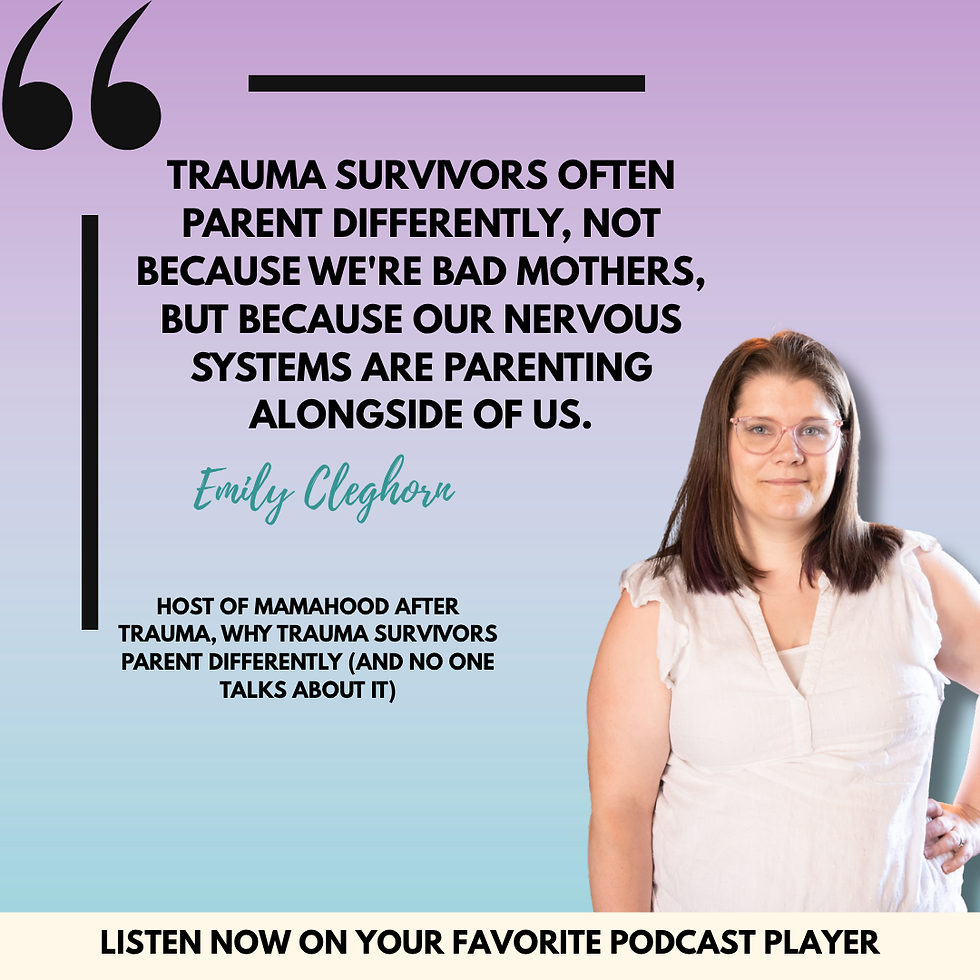
Trauma survivors parent differently—not because they’re bad parents, but because their nervous systems are wired for survival.
Why?
Your nervous system interprets ordinary parenting moments through the lens of past trauma.
Everyday challenges can feel like threats, leading to disproportionate reactions.
Example:
Two mothers face a screaming five-year-old. One, raised in a safe environment, feels annoyed but not threatened. The other, raised in chaos, feels her body go into fight-or-flight.
Expert Advice:
Understand your nervous system. Sometimes, it’s not about knowing what to do—it’s about feeling safe enough to do it.
Recognize that your reactions are rooted in your history, not your worth as a parent.
Understanding Triggers: Your Child Is Not the Problem
Children don’t create your wounds, but they can activate them.
Common Trigger Scenarios:
Your child ignores you → You feel disrespected.
Your child talks back → You feel powerless.
Your child melts down → You feel out of control.
Your child pulls away → You feel rejected.
Nuanced Insight:
The intensity of your reaction is often about the past, not the present.
Your child’s behavior is a mirror, not a cause.
Actionable Advice:
Pause and reflect: When triggered, ask, “What old story is being activated right now?”
Separate the past from the present: Remind yourself, “This is about me, not my child.”
The Motherhood Mirror: When Old Wounds Surface
Motherhood doesn’t just bring out your best—it brings out your wounds.
Why is this so hard?
You’re not just raising a child; you’re confronting your own childhood.
Your child’s needs and behaviors can highlight unmet needs or unresolved pain from your past.
The Cycle-Breaker’s Dilemma:
Many trauma survivors fear becoming their parents.
When you slip up—yell, snap, or shame—you may feel crushing guilt and shame.
Expert Reframe:
One moment of dysregulation does not erase your progress.
Cycle breaking is about what you do next—not about never making mistakes.
Breaking the Cycle: It’s Not About Perfection
There’s immense pressure to “break the cycle” perfectly.
The Reality:
You will get triggered.
You will make mistakes.
The difference is in your response: Do you repair? Do you reflect? Do you get curious?
Key Practices:
Repair: Apologize and reconnect after ruptures.
Awareness: Notice your triggers and responses.
Curiosity: Ask, “What’s happening inside me?” instead of shaming yourself.
Actionable Advice:
Model repair for your children. Show them that relationships can withstand conflict and be mended.
Let go of the need to be perfect. Focus on being present and willing to learn.
The Need for Control and Parenting from Fear
Control is a common coping mechanism for trauma survivors.
Why?
If your childhood was unpredictable, control feels safe.
Parenting, however, is inherently unpredictable.
The Challenge:
Children are messy, emotional, and don’t always cooperate.
Trying to control everything leads to more stress and reactivity.
Expert Insight:
Notice when fear is driving your parenting.
Ask yourself: “Am I responding to what’s happening now, or to what I’m afraid might happen?”
Actionable Advice:
Practice tolerating uncertainty. Remind yourself, “This is hard, but I am safe.”
Shift from control to connection. Focus on creating safety, not rigidity.
Repair Over Perfection: What Your Child Really Needs
Your child doesn’t need a perfect mother—they need a mother who is willing to come back.
What matters most:
Repair: Acknowledge when you’ve messed up. Apologize. Try again.
Connection: Show your child that the relationship is safe, even after conflict.
Emotional Permission: Allow all feelings—yours and theirs.
Key Points:
The goal isn’t to prevent all anger or conflict, but to show that these can be survived and repaired.
Children learn resilience and emotional safety from seeing you navigate hard moments, not from your perfection.
Actionable Advice:
After a rupture, say: “I got really frustrated. I’m sorry I yelled. That wasn’t your fault. Let’s try again.”
Model emotional regulation and repair. This teaches your child that relationships can heal.
Action Steps: Moving from Shame to Curiosity
If you’ve already “messed up,” you are not disqualified.
You can:
Start today.
Repair and reconnect.
Get curious about your triggers.
Separate the past from the present.
Choose a new response.
Reflective Practice:
Recall a recent trigger. What did your child do? How did you react?
Ask: “What did I believe that meant?” For example, “They don’t respect me” or “I’m failing.”
Get curious: Is this belief rooted in the present or the past?
Pause: Use this awareness to create space before your next response.
Expert Encouragement:
The most powerful shift is from “I should have done better” to “I wonder what happened inside of me.”
Curiosity is the beginning of healing.
Final Thoughts: Healing Out Loud
Motherhood didn’t cause your trauma, and your children aren’t responsible for healing it.
But motherhood can shine a light on the parts of you that still need attention and care.
You are not a bad mother because you get triggered. You are a human mother with a history.
The work is not to erase your history, but to stop letting it dictate every response.
You can:
Learn.
Repair.
Change.
Become the mother you needed—not by being perfect, but by being present, curious, and willing to grow.
Resources
Emily Cleghorn’s Free Quiz: “Find Your Next Step to Calm and Healing”.
If you’re a mama healing from trauma and seeking a new way forward, remember: You deserve support, your child deserves joy, and together, you can break cycles and build a brighter future.


Comments